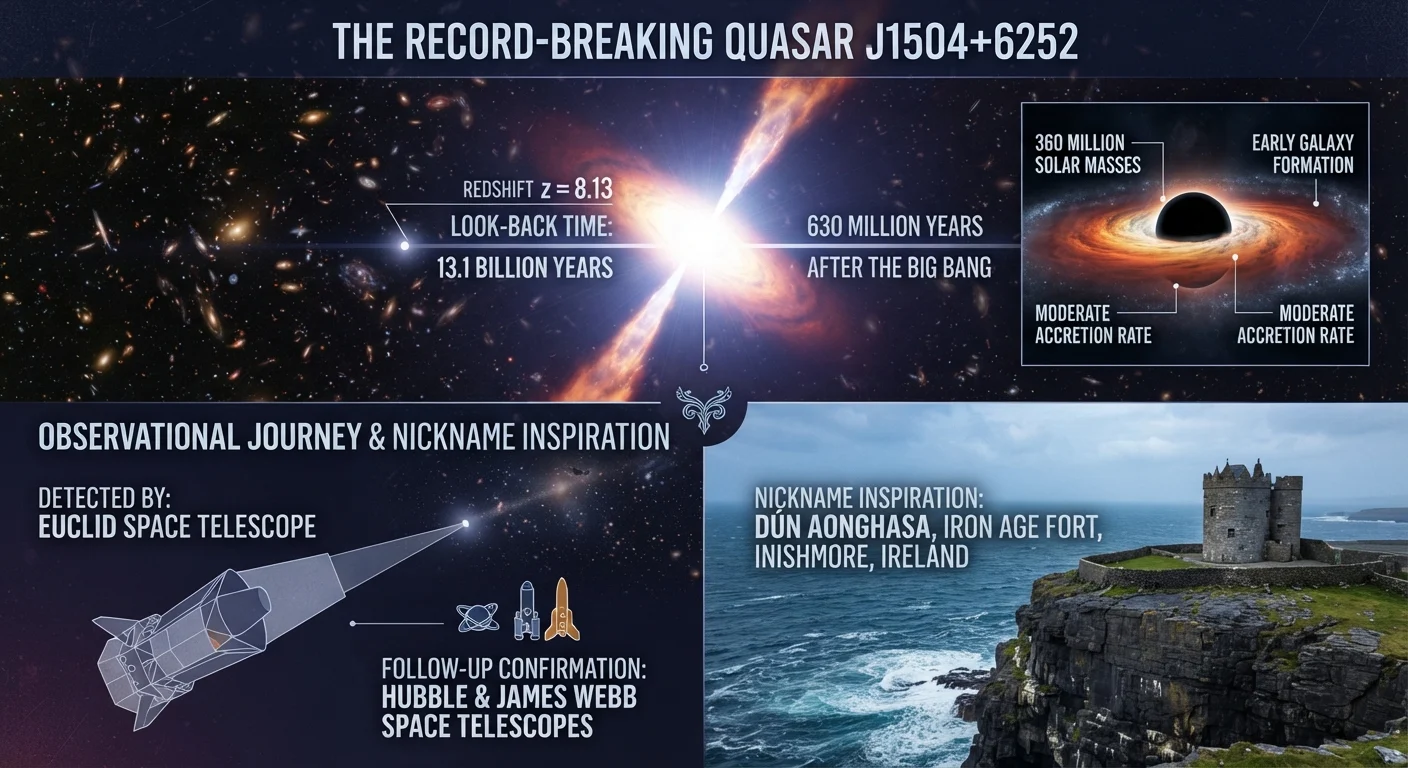
Astronomers have identified the most distant quasar ever confirmed, pushing observational records back to roughly 630 million years after the Big Bang. Detected first by the European Space Agency’s Euclid space telescope and published in Astronomy & Astrophysics, the object—formally cataloged as J1504+6252 and nicknamed Dún Aonghasa—is powered by a supermassive black hole weighing about 360 million times the mass of the Sun.
A Record-Breaking Redshift
Light from J1504+6252 has traveled across an expanding universe for more than 13 billion years, stretching its wavelengths into the infrared range. Researchers measured a redshift of z = 8.13, making it the first quasar found past a redshift of 8 and beating the previous distance record by roughly 40 million years earlier in cosmic history.
Lead author Julien Wolf and colleagues combed through roughly 18 months of Euclid survey data to flag candidate objects before confirming the distance and properties with follow-up observations from space- and ground-based telescopes, including the Hubble and James Webb space telescopes. Because quasars shine brightly as gas and dust spiral into their central black holes, they act as valuable beacons for studying conditions during the universe’s earliest chapters.
How Such a Massive Black Hole Formed Early
Finding a 360-million-solar-mass black hole when the universe was barely five percent of its current age sharpens a long-standing question in astrophysics: how do supermassive black holes grow so large so quickly?
Standard models in which a black hole starts as the remnant of a single massive star and steadily pulls in surrounding gas struggle to produce such a giant in only 630 million years. Instead, the discovery lends weight to alternative formation pathways. Massive clouds of primordial gas may have collapsed directly into relatively large "seed" black holes, giving them a substantial head start. Alternatively, the black hole may have undergone brief, intense episodes of rapid feeding earlier in its history.
Interestingly, spectroscopic measurements indicate that J1504+6252 is currently consuming material at a moderate, steady pace rather than an extreme runaway rate. That measured appetite suggests its enormous mass was built up well before the moment astronomers are now observing.
Named for an Irish Cliffside Fort
Wolf nicknamed the quasar Dún Aonghasa after the prehistoric stone fort perched on the cliffs of Inishmore in Ireland’s Aran Islands—a place overlooking a vast horizon that echoed the team’s view into the early cosmos.
Because Euclid is still early in its mission to map billions of galaxies across a third of the sky, researchers note that this record may not stand for long. As more survey data is processed, astronomers expect to uncover even older quasars, offering a clearer picture of how the first galaxies and black holes took shape.